
SORBA.ai turns your reliability and process engineers into the people who build predictive models, anomaly detection, process optimization, and decision support, without requiring a data science team. Portainer deploys, updates, and governs those applications across every site without a path out to a vendor's cloud or infrastructure your team has to build by hand.
Industrial AI initiatives usually start as isolated pilots and stay there. Fragmented data systems, inconsistent infrastructure, cybersecurity requirements, limited IT/OT resources, and the sheer operational load of managing software across multiple sites all get in the way before a model ever reaches full production.
Reliability and process engineers understand the equipment, but building and maintaining AI models has usually required a team most plants don't have.
A model proven on one line or one plant usually means rebuilding the same integration work by hand at every additional site.
When a model contributes to a control decision, auditors need to know who built it, when, and what it was trained on.
Every additional plant connected for monitoring usually means another inbound port to open, manage, and defend.
New model versions, patches, and configuration changes pushed one site at a time stop scaling past a handful of plants.
SORBA.ai builds and runs the models on your own plant data. Portainer deploys, updates, and governs them identically across every site, the same way it manages every other containerized application at the edge.
SORBA.ai's no-code platform lets the reliability and process engineers who already understand your equipment build predictive models, anomaly detection, process optimization, and decision support directly from plant data.
One manifest reaches every plant server and edge gateway in the fleet, whether that's one site or a dozen across three continents, the same rollout used for every other application already running on Portainer.
New SORBA.ai versions roll out through Portainer's pipeline. A failed update reverts automatically, and access stays role-based per site and per team.
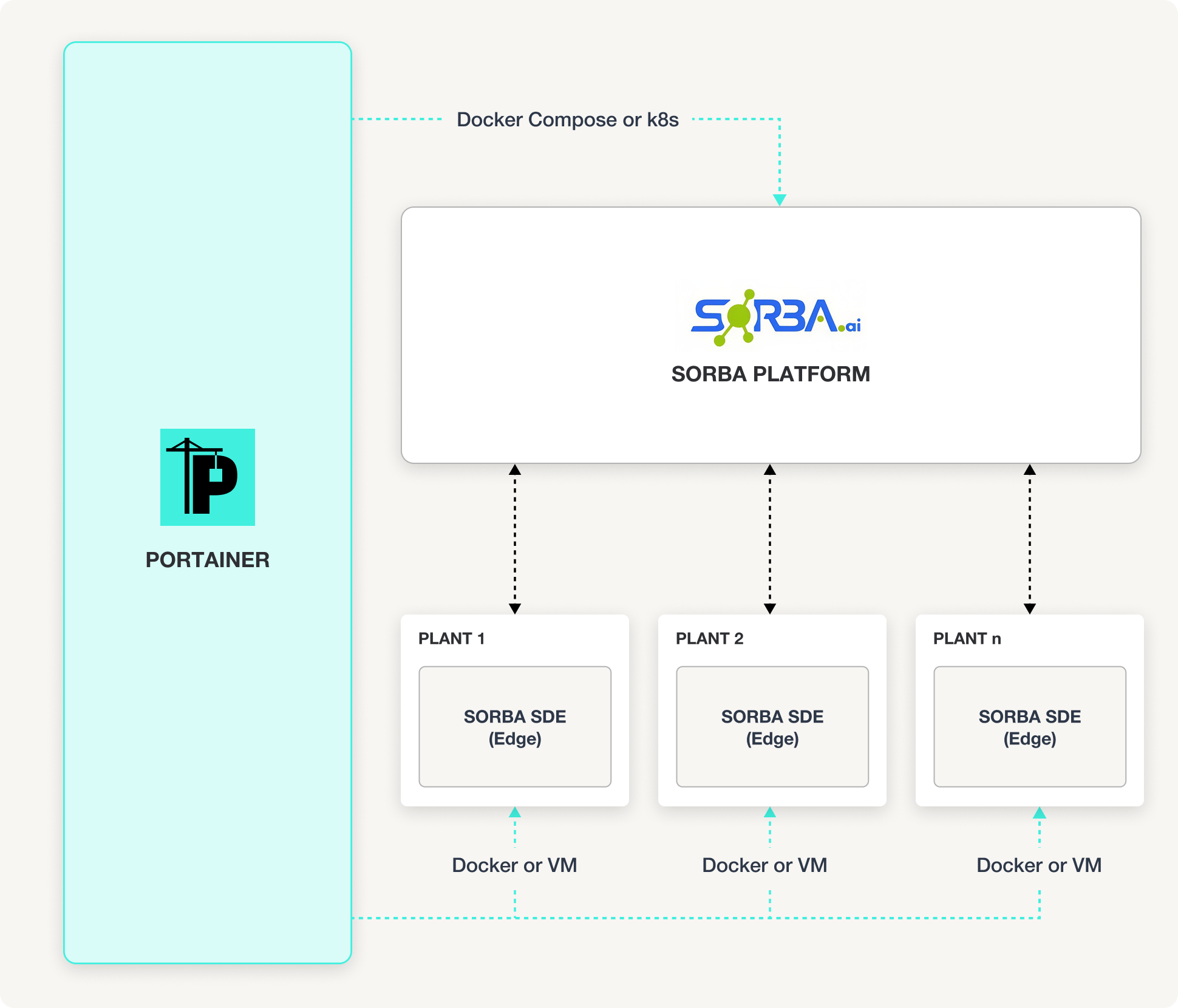
SORBA.ai runs as two tiers. A central SORBA Platform builds and manages the models; a SORBA SDE instance runs at the edge of every plant it's deployed to. Portainer deploys the platform tier through Docker Compose or Kubernetes and the edge tier through Docker or a VM, and manages both directly, so a new plant means running the same deployment again, not a bespoke install.
Plant data rarely arrives in one consistent format. An Ignition Edge gateway sits in front of the machines, normalizing legacy and modern protocols into a single MQTT stream, so SORBA.ai deals with one transport regardless of what's on the floor. SORBA.ai ingests that stream, tags it, and builds an ontology over it, turning an anonymous reading into a known measurement tied to a known asset. That's where predictive models, anomaly detection, process optimization, and decision support come from. A separate component, tuned specifically for interpreting this kind of industrial output in plain language, sits on top for teams who want findings explained rather than just surfaced.
Talk to our industrial team about your OT deployment.